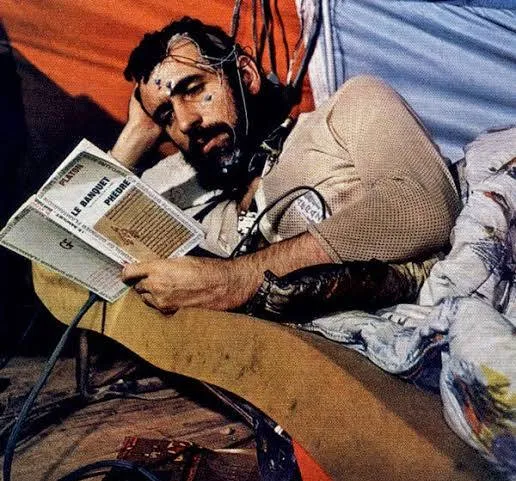
The Cave Beneath the Age: Michel Siffre and the Work of Sean Dempsey
There is something terribly sad about a man who goes looking for answers in the darkness, particularly when he is convinced that the darkness has answers to give. In 1972, the French scientist Michel Siffre descended into a cave beneath the earth, leaving behind the sun, the stars, the comforting rhythm of human company, and that curious little tyranny by which men have measured their lives for centuries: the clock. He went willingly, even eagerly, possessed of that peculiar scientific courage which allows a man to regard his own mind as something to be dissected, something to be tested and tormented in the service of knowledge. And perhaps there was courage in it. Perhaps there was also a little madness. For what Siffre proposed to discover was whether man could understand time without the world to measure it for him, and what his experiment revealed was how profoundly the human mind depends upon the world it so confidently believes itself capable of understanding.
It is difficult to think of this lonely Frenchman without feeling some tenderness toward him. Somewhere above his head the ordinary affairs of humanity continued in their noisy and magnificent absurdity. Children quarreled, lovers embraced, old men watched the evening settle upon their gardens, and the clocks of Paris dutifully announced the passing of hours that Siffre could no longer distinguish. The butcher opened his shop, the priest prepared his sermon, a young woman waited impatiently for a letter that would never arrive, and somewhere a mother kissed her sleeping son upon the forehead, wholly unaware that she was performing one of those small miracles upon which the entire world depends. Down below, there was only the darkness, and his breathing, and the dreadful companionship of his own thoughts. One wonders at what moment the experiment ceased to feel like an experiment. At what moment the silence, which he had entered as a scientist, began to address him as a man.
For silence is a peculiar thing. We praise it when we cannot find it, dread it when it finds us, and spend much of our lives filling it with whatever trivial distractions happen to be within reach. We surround ourselves with conversation, occupation, music, politics, the vulgar entertainments of the day, and all the little ceremonies of civilized existence, partly because these things give pleasure, but partly, I suspect, because they relieve us of the burden of being alone with ourselves. A man may spend forty years convinced of his own sincerity, his own courage, his own philosophical independence, and discover in one terrible hour of solitude that he has never seriously examined a single conviction he possesses. There is no one to impress in the darkness. No congregation to applaud his virtue, no adversary against whom to measure his intelligence, no sympathetic audience to reassure him that his suffering is noble. There is merely himself, which may be the most intolerable company of all.
Yet I am reluctant to make Siffre’s descent into some grand parable of suffering, for he was, after all, a scientist pursuing scientific questions. His experiment concerned the rhythms of human biology, the mysterious internal mechanisms by which our bodies distinguish sleep from wakefulness and one day from another. These are substantial questions, deserving of their own answers. But science has an unfortunate habit of stumbling upon philosophical mysteries it never intended to disturb. A physician examining the heart may find himself troubled by the mystery of love. An astronomer calculating the distance between stars may suddenly become conscious of the terrible smallness of his own existence. And a man who descends beneath the earth to investigate the passage of time may leave us wondering whether the ordinary measures of our lives are the only things preventing us from drifting into a chaos we have scarcely begun to comprehend.
There is a strange historical poetry in the timing of this descent. For while Siffre was surrendering himself to the darkness beneath France, another sort of darkness was gathering in the intellectual life above it. The old certainties were being questioned with increasing ferocity. Truth, once imagined as something waiting patiently to be discovered, was becoming something rather less solid, less universal, perhaps even something fashioned by the individual mind. The great stories by which civilizations had explained themselves were being stripped of their authority. In the universities, in the cafés, in the feverish pages of French philosophy, a new suspicion was taking hold: that perhaps there was no fixed center to human existence at all. What an extraordinary coincidence, and what an unsettling one, that a man should choose precisely this moment to bury himself alive in a world without external reference, while his countrymen above were busily dismantling the philosophical equivalents of the sun and stars.
I do not suppose that Michel Foucault, Jacques Derrida, or the other formidable intellects associated with the philosophical upheavals of that era would have approved of such a tidy comparison. Philosophers are seldom pleased to discover their intricate arguments reduced to the predicament of a fellow sitting alone in a cave. And the intellectual history is far more complicated than any single metaphor can accommodate. Much of what these thinkers challenged deserved challenging. The twentieth century had furnished humanity with ample evidence that its most cherished claims to reason, progress, and moral superiority could coexist quite comfortably with extraordinary barbarism. The old certainties had not always served us particularly well. Some had become instruments of cruelty. Others had simply grown too exhausted to bear the weight of a changing world.
But there is a difference between recognizing that men have mistaken falsehood for truth and concluding that truth itself is forever beyond our reach. The first recognition may be the beginning of wisdom. The second carries with it a temptation toward despair, or worse, toward an indifference so thoroughly disguised as sophistication that one scarcely recognizes it as despair at all.
A civilization cannot live indefinitely upon suspicion. It must eventually find something it is willing to love without embarrassment.
This, I think, is one of the great spiritual difficulties of our age. We have inherited an extraordinary capacity for criticism, an almost athletic talent for finding hypocrisy in every institution, selfishness beneath every profession of virtue, and some hidden instrument of power behind every declaration of principle. Often the suspicion is justified. It has exposed enormous falsehoods and humbled authorities that badly needed humbling. Yet we seem to have acquired the habit of treating sincerity itself as evidence of intellectual weakness. To believe deeply is to risk appearing foolish. To love a country is to invite a lecture upon its crimes. To honor a tradition is to be reminded of everyone it once excluded. Even the simple declaration that a thing is beautiful can provoke an interrogation into the social conditions that made such a judgment possible.
One grows rather tired of being clever in this fashion.
The human heart, whatever our philosophers may say of it, has never been entirely satisfied with the discovery that everything is complicated. A child does not love his mother provisionally, pending a satisfactory examination of her moral and historical assumptions. A grieving husband does not stand beside his wife’s grave and console himself with the sophisticated observation that personal identity is socially constructed. There are moments when the elaborate intellectual architecture of the modern world falls away, and what remains is terribly simple. A hand we can no longer hold. A voice we shall never hear again. A room that has become unbearable because someone who once inhabited it is gone.
If the language of philosophy cannot make room for such things, then perhaps it is philosophy, and not the grieving man, that has lost its way.
And here we begin to approach the peculiar emotional territory occupied by the writings of Sean Dempsey. His books, varied as they are in subject and temperament, return repeatedly to human beings attempting to preserve some small measure of dignity in a world that has grown increasingly uncertain of what dignity means. Sometimes the struggle is political. Sometimes it is personal, familial, or philosophical. Often it is absurd in a manner that would have delighted Kafka, had Kafka possessed the luxury of observing modern American bureaucracy. But beneath the arguments, the indignation, the satire, and the occasional flashes of quite deliberate irreverence, one detects a persistent and rather vulnerable question: what is a person supposed to do when the world upon which he has relied begins to betray him?
It is a question that sounds comfortably abstract until life has occasion to ask it of us personally.
We are all, in certain moments, Michel Siffre in his cave. The darkness arrives in different disguises. For one man it is a diagnosis, for another the sudden collapse of a marriage, for another the terrible discovery that an institution he had trusted has turned against him. Sometimes it arrives quietly, in middle age, when the great ambitions that once animated a life have grown less convincing, and the familiar consolations begin to seem like the decorations of an empty room. At other times the darkness is imposed by force, and there is no meaningful opportunity to prepare for it. The ordinary furniture of existence is removed, one piece at a time, until the person standing amid the wreckage scarcely recognizes the life he once called his own.
What interests me in Dempsey’s work is his recurrent suspicion that the modern world has become unusually proficient at producing such darkness while congratulating itself upon the quantity of light it has created.
We are richer in information than any civilization before us, and perhaps poorer in wisdom. We have accumulated institutions devoted to the protection of human welfare, and yet we sometimes find that the individual human being has vanished entirely from their considerations. We have perfected a language of rights, compassion, progress, and inclusion, while growing curiously skilled at making cruelty sound benevolent. It is a strange accomplishment, one that deserves to be admired only in the way a man might admire the engineering of an exceptionally sophisticated gallows.
Dempsey is particularly attentive to the distance between what institutions claim to be and what they become when their authority is challenged. In I Am William Woods, the question of personal identity assumes a frighteningly literal character. A human life, with its memories, its private suffering, its accumulated understanding of itself, comes into conflict with the official mechanisms by which identity is recognized and recorded. The contradiction is maddening. A man knows who he is, yet discovers that knowledge may count for very little against the authoritative pronouncements of those entrusted to determine such things.
It would be easy to regard this as merely an indictment of bureaucracy, and there is certainly enough bureaucratic absurdity in the modern world to sustain several lifetimes of indignation. But I think the deeper tragedy concerns our dependence upon recognition. We imagine identity to be something we possess, like a name or a face. In truth, much of our existence depends upon other people acknowledging that we are who we believe ourselves to be. The husband is a husband partly because he is loved as one. The father is a father because there are children who know him by that name. The citizen possesses rights because a political community has undertaken to recognize them. Remove the recognition, or transfer its authority entirely to an institution incapable of understanding the person before it, and something profoundly disturbing happens. The individual remains physically present, yet the world begins to behave as though he has disappeared.
There is a special cruelty in being forced to argue for the reality of one’s own existence. The victim must furnish evidence, submit explanations, endure examinations, and patiently correct the mistakes of people who may possess no particular interest in correcting them. All the while, life continues. Meals must be eaten. Bills must be paid. The sun rises with its customary indifference. It is difficult to imagine a more pitiless humiliation than the discovery that one’s deepest suffering has become, to someone else, an administrative inconvenience.
And perhaps the most unsettling element is how little malice is required to sustain such a tragedy. A system may destroy a person’s life without any single participant possessing sufficient hatred to wish for that destruction. One official follows procedure, another defers responsibility, a third awaits authorization, and a fourth has gone home for the weekend. Each may consider himself a decent man. Together they may accomplish something monstrous.
Kafka understood this long before the computer made the process so efficient.
In Dead Stars Shine Brightest, the conflict between institutional order and the human heart acquires an altogether different urgency. Here the agony of a father confronted with danger to his child brings the abstract question of obedience into the most intimate chamber of moral life. Institutions exist, we are told, to preserve order and protect the innocent. We are asked to respect their procedures, trust their judgment, and resist the dangerous arrogance of believing that our personal instincts should prevail over established authority. These are not trivial expectations. Civilization depends upon some measure of restraint, and the world would be a miserable place if every outraged individual felt entitled to become his own legislature, judge, and executioner.
Yet there are moments when obedience demands more than a human being should be asked to surrender.
What does a father owe to a system that has failed his child? What does he owe to the child herself? It is easy enough to construct a noble answer from the comfort of an armchair, particularly when no one we love is crying out for help. But the human heart is not an armchair philosopher. It does not weigh the suffering of a daughter against the dignity of institutional procedure with the serene detachment of a committee. It knows the sound of her laughter. It remembers the smallness of her hand in his. It knows that once, not so very long ago, he carried her sleeping from the car and lingered beside her bed, astonished that anything so fragile and so precious had been entrusted to his care.
What magnificent nonsense our abstractions can become when measured against such love.
And yet love itself is no guarantee of wisdom. That, too, must be admitted. The ferocity of paternal devotion can be noble, but it can also blind. The desire to protect those we cherish has excused its share of cruelty, and history is crowded with men who were quite certain that love justified whatever they had chosen to do. The moral difficulty cannot be escaped by declaring the father innocent and the institution guilty before the tragedy has been examined. It resides precisely in the uncertainty, in the terrible possibility that a person may be forced to choose between obligations that cannot peacefully coexist.
Dempsey’s recurring concern with authority becomes more explicitly political in Trump AGAIN?!?, though here the absurdity is less intimate and considerably louder. The modern political world has cultivated a form of collective enthusiasm in which consistency is treated as an optional virtue and intellectual independence as a suspicious eccentricity. Men who yesterday denounced a particular exercise of power discover today that it is indispensable, provided the power has passed into friendly hands. Principles are preserved in public declarations and quietly abandoned in private calculations. A political movement becomes a sort of portable morality, capable of adjusting itself to whatever circumstances may be necessary for the maintenance of allegiance.
The spectacle would be genuinely amusing if it did not exercise so much authority over the lives of people who never consented to participate in the comedy.
The deeper loss is a loss of language. When the meanings of justice, liberty, truth, and compassion become dependent upon the political sympathies of the speaker, we surrender something far more precious than the prospect of a reasonable election. We surrender the possibility of understanding one another. A society may survive enormous disagreements, and sometimes grow stronger through them. What it cannot easily survive is the suspicion that every declaration of principle conceals a private exception, every appeal to conscience a calculation of advantage, and every public moral certainty an invitation to hypocrisy.
The cave, in such circumstances, begins to seem rather attractive. At least a man alone in the darkness is spared the obligation of applauding what he knows to be absurd.
But there is another danger here, one that Dempsey’s interest in metamodernism helps illuminate. The cynical man, having exposed hypocrisy everywhere, can begin to mistake his suspicion for wisdom. He becomes so accustomed to disappointment that he congratulates himself upon expecting nothing. He calls this realism, and perhaps for a time it offers him protection. Nothing can wound him if nothing is worthy of his faith. Nothing can betray him if he refuses to trust. Yet the protection is purchased at a dreadful price, for the person who has trained himself never to believe in anything has also made it terribly difficult to love.
And what is to become of a civilization populated by people who are too intelligent to hope?
I confess that this question interests me more than the political disputes themselves. Our age has produced countless clever men, skilled in the exposure of falsehood, fluent in the vocabulary of suspicion, and possessed of an apparently inexhaustible appetite for demonstrating that the world is less noble than it pretends to be. What we seem to lack are men willing to acknowledge these disappointments and continue loving the world anyway. There is a courage in such affection that cynicism will never understand. It requires a person to remain vulnerable after vulnerability has proved costly, to believe without the luxury of certainty, and to preserve tenderness in circumstances that have furnished ample justification for bitterness.
One might call this foolishness. I suspect it is among the few forms of wisdom worth possessing.
Which brings me, rather unexpectedly, to In Search of Lake Weslemkoon, a work that seems at first to inhabit an altogether different universe from Dempsey’s political and institutional preoccupations. Here we encounter the gentler materials of memory, family, landscape, and the fleeting incidents of ordinary life. The philosophical scaffolding has not disappeared, but it no longer announces itself with such insistence. The reader is invited to linger beside a lake, to contemplate the passing of childhood, to consider the strange emotional permanence of places that the world itself has long since begun to change.
And there is something almost unbearably tender about this movement toward the ordinary.
A lake can be a peculiar repository of human feeling. We return to its shores believing that we have come to revisit a place, when in truth we are searching for people who no longer inhabit the world in quite the same way. The boy who once hurried barefoot toward the water has become a man with responsibilities and disappointments of his own. The parents who seemed impossibly permanent have grown older. The conversations that once filled the summer air have become fragments of memory, preserved imperfectly, embellished by affection, and sometimes mourned with an intensity entirely out of proportion to their apparent importance.
A broken rope. A misplaced Lego. The small indignities and pleasures of family life. None would interest the historian, and scarcely one would warrant preservation in the official records of mankind. Yet they may contain more of the substance of a human existence than all the grand pronouncements issued by the institutions that presume to speak on humanity’s behalf.
I am reminded of the strange injustice by which we measure the importance of events. A war may command the attention of nations, a political speech may occupy the newspapers for days, and a celebrated philosopher may spend a lifetime constructing an elaborate explanation of human consciousness. Meanwhile, a father sits beside his child upon a quiet summer evening, listening to the water move against the shore, and something passes between them that neither can adequately describe. Fifty years later, the child may have forgotten the philosopher and the politician alike. But the sound of that water may return to him with such unexpected force that he must stop whatever he is doing and grieve for an evening he had not realized was lost.
What, then, was the important event?
Here, perhaps, the philosophical darkness of Siffre’s cave encounters its most affecting contradiction. For the human being is not sustained by certainty alone. We need more than a reliable account of time, an agreed vocabulary of truth, or a coherent system of political and moral principles. We need the touch of another person, the companionship of memory, the knowledge that somewhere in the world there is a place to which our affections belong. We need beauty, even when beauty is of no conceivable practical use. We need laughter in the midst of disaster, and the permission to weep over things that the rational mind considers too small to deserve our sorrow.
For all our ingenuity, we remain creatures who can be undone by a familiar smell, a forgotten photograph, or the discovery of an old letter in a drawer.
And I wonder whether the modern world, in its relentless pursuit of progress, has given sufficient thought to the things it asks us to leave behind. Progress is a magnificent word, and one that has justified innumerable genuine improvements in the human condition. But it possesses a rather cruel indifference to memory. The new road is built, the old house demolished, the lakefront developed, the familiar landscape altered beyond recognition, and those who mourn what has vanished are gently informed that change is inevitable. Which, of course, it is. Death is inevitable too, but no sensible person would suggest that inevitability makes grief unreasonable.
Perhaps there is a kind of quiet resistance in remembering. To preserve a childhood afternoon, to write lovingly of a place that will someday exist only in recollection, to insist that a broken rope or an old family story deserves a little corner of literary immortality, is to rebel against the great machinery of forgetting. It is to declare that the ordinary human life, with all its lovely and ridiculous particulars, possesses a dignity that no system of measurement can adequately capture.
And so I return, somewhat reluctantly, to Michel Siffre beneath the earth. I imagine him reaching for a clock that is not there, searching the darkness for some familiar indication of the hour, and realizing that the world above has continued its journey without offering him the smallest reassurance of his place within it. I imagine the loneliness of that realization, and the stubborn courage required to remain where he had chosen to go. There is a certain nobility in the attempt to understand oneself through deprivation, though I cannot escape the feeling that the most valuable things in life are often those we discover only after they have been taken away.
What must the sunlight have meant to him when he returned? What must an ordinary conversation have felt like, or the sight of another human face? We may describe the experiment in scientific terms, measure its findings, and place its conclusions among the accumulated achievements of human knowledge. Yet there remains something that the measurements cannot quite reach: the private astonishment of a man restored to the ordinary world, and the possibility that everything he once regarded as commonplace had become, through its absence, an object of extraordinary gratitude.
I do not know whether Siffre felt any such revelation, and it would be dishonest to attribute one to him merely because it lends itself to a pleasing conclusion. But I find myself wishing that he had. Not because suffering necessarily ennobles us, which is one of the more sentimental falsehoods humanity has contrived, but because suffering occasionally reveals the value of things that prosperity allows us to overlook.
There is no guarantee of illumination in the darkness. A cave can remain merely a cave, and a wounded man can emerge from suffering only more wounded. The universe owes us no consolation for the pains we endure. But neither is despair the inevitable reward of disillusionment. There are occasions when a person, having lost much of what once made his life intelligible, discovers some modest reason to begin again. Perhaps it is a child. Perhaps a memory. Perhaps the unexpected kindness of a stranger, or the simple, inexplicable beauty of morning light falling across a kitchen table.
Such things do not resolve the grand philosophical questions of the age. They do not establish the objectivity of truth, reconcile the quarrels of modern politics, or ensure that our institutions will become more humane. They are smaller than all that. Fragile, even. And because they are fragile, we sometimes imagine them insignificant.
But I am increasingly persuaded that the things most worth defending are often those least capable of defending themselves.
A civilization may boast of its wealth, its technology, its intellectual sophistication, and the magnificent intricacy of its institutions. It may learn to divide the atom, conquer disease, traverse oceans, and send its instruments into the cold immensities beyond the earth. It may even become clever enough to explain away the moral and spiritual foundations upon which its ancestors constructed their lives. But if, in the midst of these triumphs, it forgets how to recognize the suffering of a single human being, or loses the capacity to cherish the humble affections that make existence bearable, then something essential will have escaped its calculations.
What an extraordinary tragedy it would be if mankind, having learned to illuminate the farthest reaches of the universe, should discover that it had left the human heart in darkness.